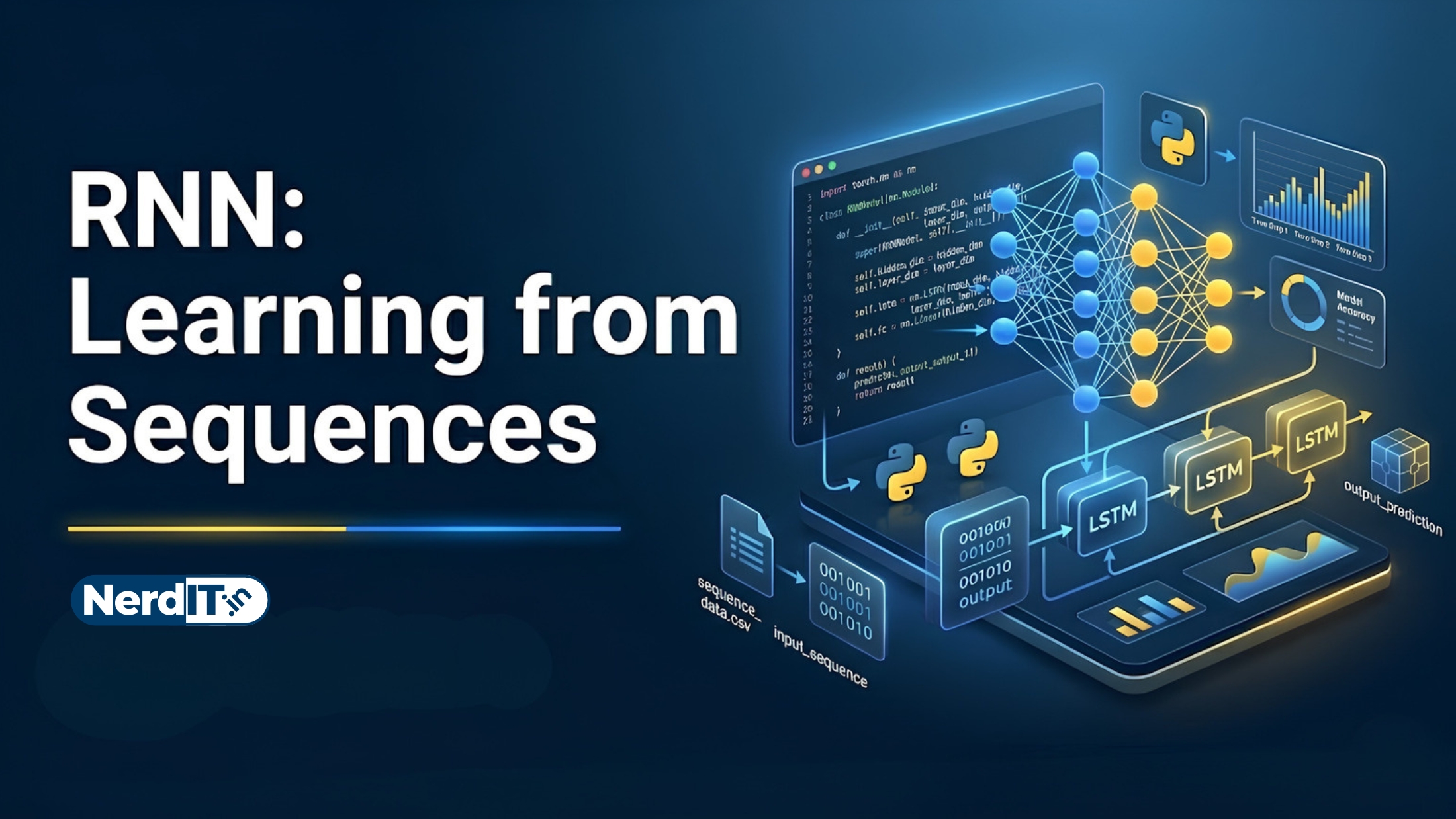
RNN: Learning from Sequences
Recurrent Neural Networks (RNN) are a type of neural network designed to process sequential data. They use feedback loops to retain information from previous steps, making them useful for tasks like text generation, speech recognition, and time-series prediction.
What's included
13
Lessons
3h 45m
Duration
Certificate
What you'll learn
Skills and outcomes you'll walk away with
Module 1: Foundations of Sequence Modeling and Simple RNNs
Module 2: The Mathematics of Backpropagation Through Time (BPTT)
Module 3: Long Short-Term Memory (LSTM) Architectures
Practical Project - 1
Module 4: Gated Recurrent Units (GRU) and Efficiency
Module 5: Sequence-to-Sequence (Seq2Seq) Models
Course curriculum
13 lessons • 3h 45m total
RNN: Learning from Sequences13 lessons
Module 1: Foundations of Sequence Modeling and Simple RNNs
Module 2: The Mathematics of Backpropagation Through Time (BPTT)
Module 3: Long Short-Term Memory (LSTM) Architectures
Practical Project - 1
Module 4: Gated Recurrent Units (GRU) and Efficiency
Module 5: Sequence-to-Sequence (Seq2Seq) Models
Module 6: Attention Mechanisms in RNNs
Practical Project - 2
Module 7: Advanced RNN Variants and Bidirectionality
Module 8: Generative RNNs and Language Modeling
Module 9: Real-World Applications and Deployment
Practical Project - 3
Module 10: Optimization, Hardware, and the Future
Certification path
Certification exam
30 multiple-choice questions • 70% passing score required
Final Project: Advanced Sequence Modeling with LSTMs and GRUs
In this final assignment, students will design and implement two distinct RNN-based models. Part one requires building a many-to-one architecture for sentiment analysis on a provided movie review dataset. Part two involves constructing a many-to-many architecture for multi-step time series forecasting of energy consumption data. Students must demonstrate proficiency in handling vanishing gradients, implementing dropout for regularization, and optimizing sequence length through padding and truncation techniques. A final report must compare the performance of Vanilla RNNs, LSTMs, and GRUs for these specific tasks.
Verified certificate
Earn a verified PDF certificate with unique verification ID upon completion • ₹299
Related courses
More free AI & Data Science courses with verified certificates
 Mathematics for Data Science: Linear Algebra & CalculusBeginner
 Machine Learning FundamentalsIntermediate
 Mastering Linear Regression: Theory & ImplementationBeginner
 Mastering Random Forest AlgorithmsIntermediate
Reviews & ratings
No reviews yet — be the first!
Free
Free course — learn at your own pace
Certificate: ₹299
Your certificate preview
₹299 — pay only to certify
NIT-8F3K-2Q7AThis is to certify that
has successfully completed the course
- Unique verification ID — provably genuine
- Shareable & ready for your LinkedIn profile
- Verifiable by anyone, anytime on our verify page
- Learn 100% free — the certificate is optional