Python OOP Programming
This Python Object-Oriented Programming (OOP) course is designed to help you transition from writing basic scripts to building scalable, professional-grade software. We focus on the core principles that drive modern application development, ensuring you gain the "industry-ready" logic needed for complex projects.
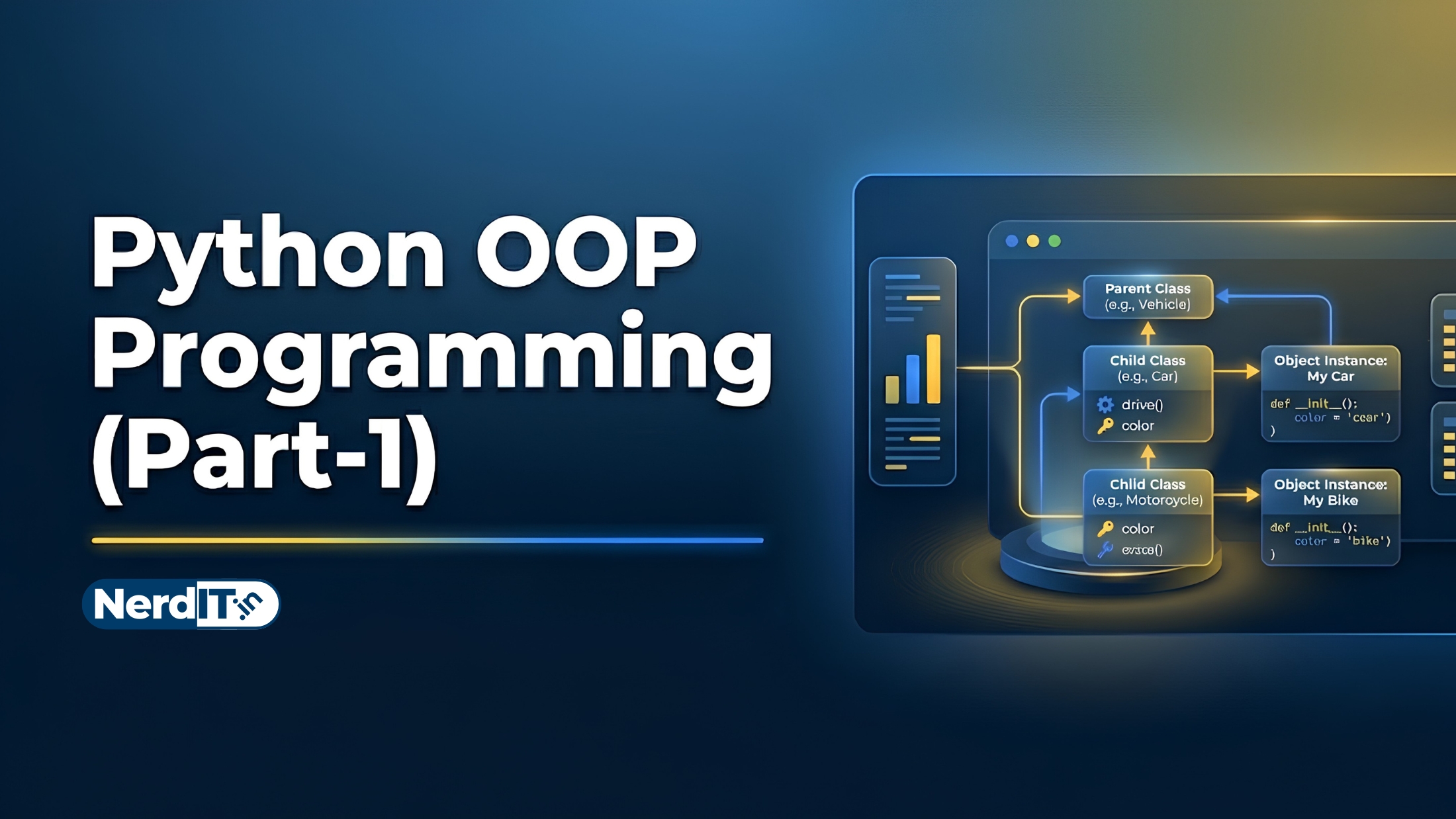
What's included
20
Lessons
26h 23m
Duration
Certificate
What you'll learn
Skills and outcomes you'll walk away with
Module1: Introduction to OOP Programming
Module 2: Classes and Objects
Module 3: Types of Variables in a Class
Module 4: Types of Methods
Module 5: Constructors in Depth
Module 6: Access Modifiers & Encapsulation
Course curriculum
20 lessons • 26h 23m total
Python OOP Programming20 lessons
Module1: Introduction to OOP Programming
Module 2: Classes and Objects
Module 3: Types of Variables in a Class
Module 4: Types of Methods
Module 5: Constructors in Depth
Module 6: Access Modifiers & Encapsulation
Module 7: The @property Decorator
Module 8: Inheritance
Module 9: Multiple Inheritance
Module 10: Abstract Classes
Module 11: Polymorphism
Module 12: Operator Overloading (Magic / Dunder Methods)
Module 13: Method Overloading and Overriding
Module 14: Inner Classes (Nested Classes)
Module 15: Duck Typing & Advanced Polymorphism
Module 16: Iterators and Generators in OOP
Module 17: Decorators in OOP (Deep Dive)
Module 18: Exception Handling in OOP
Module 19: Advanced OOP Techniques
Module 20: Design Patterns with Python OOP
Certification path
Certification exam
60 multiple-choice questions • 70% passing score required
Python OOP Final Project: Library Resource Management System
In this final assignment, you will demonstrate your mastery of Python Object-Oriented Programming (OOP) by building a modular Library Management System. Your project must include several key components: 1. Resource Base Class: Create a class named 'Resource' with private attributes for ID and Title, using property decorators (@property and @setter) to handle encapsulation. 2. Inheritance: Create a 'Book' subclass (adding author and pages) and a 'Magazine' subclass (adding issue number). Both subclasses must override the 'display_info' method to demonstrate polymorphism. 3. Library Manager: Implement a 'Library' class that stores a collection of resources in a list and provides methods for adding new items, listing all items, and searching for an item by its unique ID. 4. Modularity: You must organize your code into separate files (e.g., resources.py and library.py) and provide a 'main.py' script that imports these modules, instantiates at least two books and two magazines, and demonstrates the search functionality. All logic should adhere to the encapsulation principles learned in this course.
Verified certificate
Earn a verified PDF certificate with unique verification ID upon completion • ₹499
Related courses
More free Development courses with verified certificates
 Supervised Machine Learning: Regression Algorithms with PythonBeginner
- TEST 3Beginner
- Introduction to Flask and RestAPIsBeginner
 Data Modelling, ETL & Data Warehousing for AnalystsAdvanced
Reviews & ratings
No reviews yet — be the first!
Free
Free course — learn at your own pace
Certificate: ₹499
Your certificate preview
₹499 — pay only to certify
NIT-8F3K-2Q7AThis is to certify that
has successfully completed the course
- Unique verification ID — provably genuine
- Shareable & ready for your LinkedIn profile
- Verifiable by anyone, anytime on our verify page
- Learn 100% free — the certificate is optional