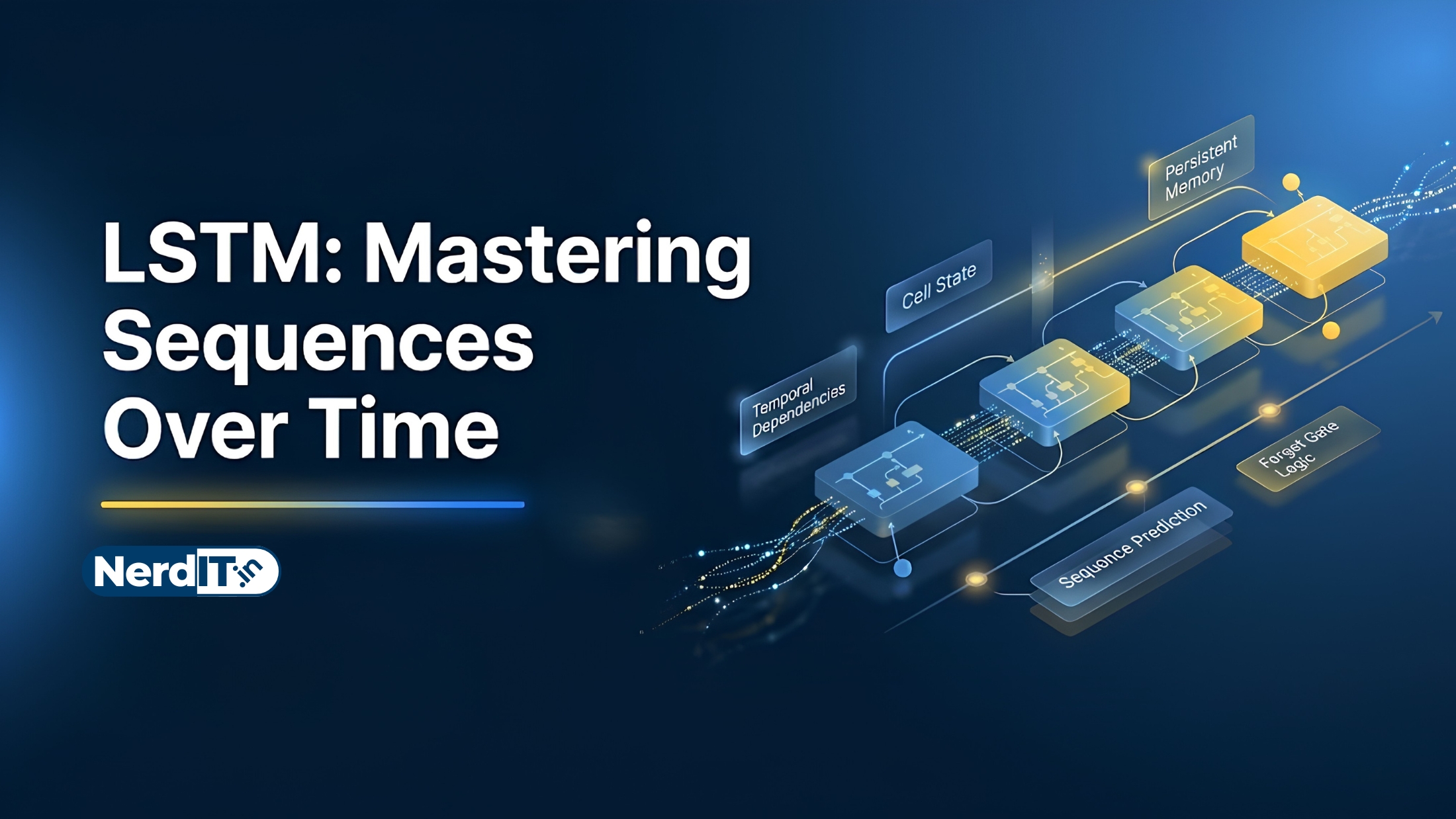
LSTM: Mastering Sequences Over Time
Long Short-Term Memory (LSTM) is a type of recurrent neural network (RNN) designed to learn from sequential data. It can remember long-term dependencies, making it effective for tasks like time series prediction, speech recognition, and natural language processing.
What's included
6
Lessons
2h 31m
Duration
Certificate
What you'll learn
Skills and outcomes you'll walk away with
Module 1: Foundations of Sequential Data and Recurrent Neural Networks (RNN)
Module 2: Introduction to LSTMs - Architecture and Core Intuition
Module 3: Implementing LSTMs in PyTorch and TensorFlow
Module 4: Advanced LSTM Architectures and Variants
Module 5: Real-World Applications and Methodologies
Module 6: Optimization, Debugging, and Specialized Topics
Course curriculum
6 lessons • 2h 31m total
LSTM: Mastering Sequences Over Time6 lessons
Module 1: Foundations of Sequential Data and Recurrent Neural Networks (RNN)
Module 2: Introduction to LSTMs - Architecture and Core Intuition
Module 3: Implementing LSTMs in PyTorch and TensorFlow
Module 4: Advanced LSTM Architectures and Variants
Module 5: Real-World Applications and Methodologies
Module 6: Optimization, Debugging, and Specialized Topics
Certification path
Certification exam
18 multiple-choice questions • 70% passing score required
End-to-End LSTM Application: Multi-Dimensional Forecasting and Textual Sequence Analysis
In this final assignment, students are required to build a robust Long Short-Term Memory (LSTM) network to solve a complex sequence prediction task. You will choose between two tracks: 1) A multivariate time-series forecasting model using real-world financial or weather data, or 2) A sequence-to-sequence model for Natural Language Processing. The project must demonstrate proficiency in data normalization, handling vanishing gradients, implementing dropout for regularization, and fine-tuning hyperparameters such as look-back windows and hidden unit counts. You are expected to provide a Jupyter Notebook containing your data pipeline, model definition, training loops, and a comprehensive analysis of the model's performance compared to a baseline such as a SimpleRNN or GRU.
Verified certificate
Earn a verified PDF certificate with unique verification ID upon completion • ₹299
Related courses
More free AI & Data Science courses with verified certificates
 Mathematics for Data Science: Linear Algebra & CalculusBeginner
 Machine Learning FundamentalsIntermediate
 Mastering Linear Regression: Theory & ImplementationBeginner
 Mastering Random Forest AlgorithmsIntermediate
Reviews & ratings
No reviews yet — be the first!
Free
Free course — learn at your own pace
Certificate: ₹299
Your certificate preview
₹299 — pay only to certify
NIT-8F3K-2Q7AThis is to certify that
has successfully completed the course
- Unique verification ID — provably genuine
- Shareable & ready for your LinkedIn profile
- Verifiable by anyone, anytime on our verify page
- Learn 100% free — the certificate is optional