Decision Tree Algorithms for Machine Learning
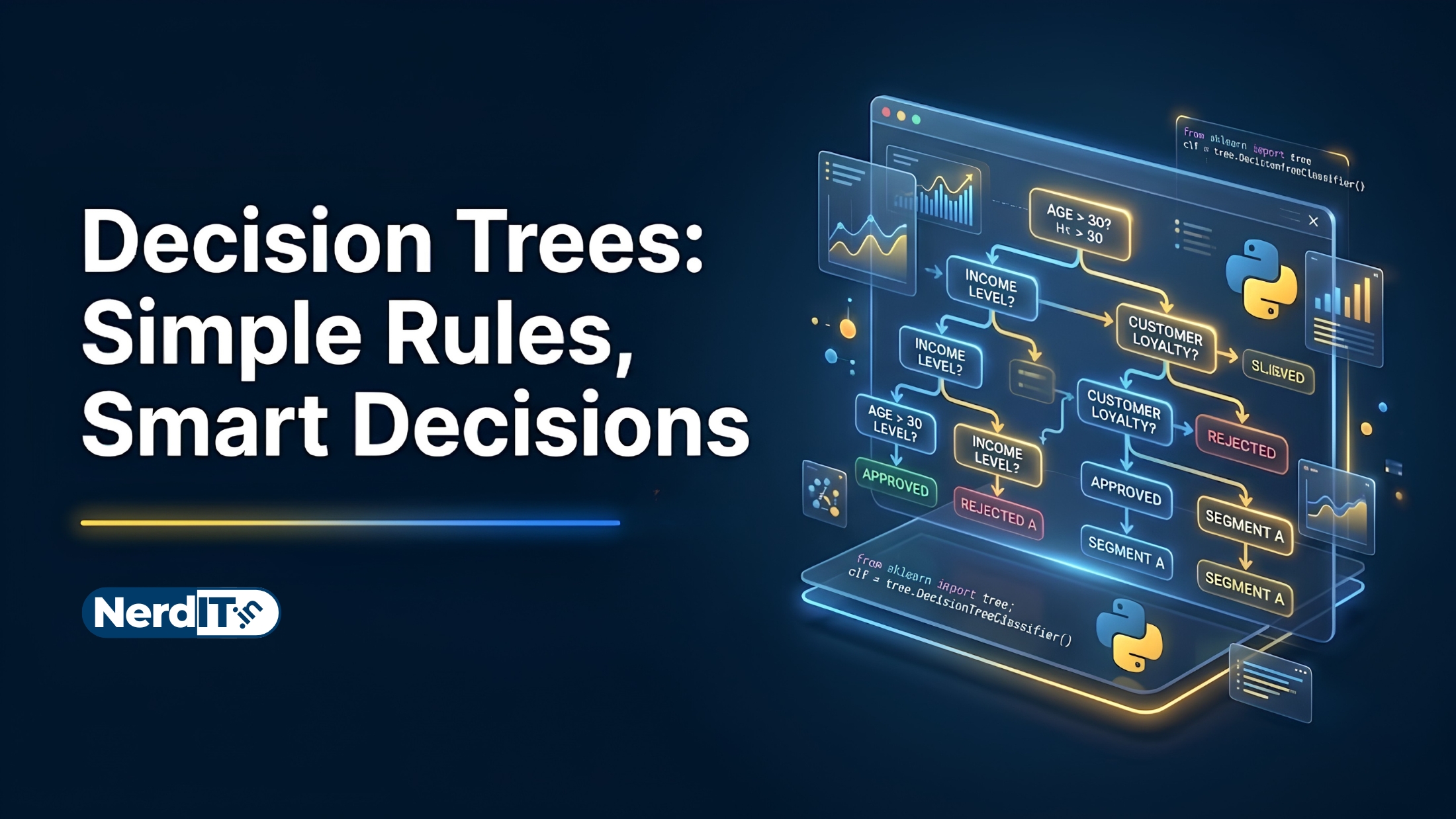
Decision Trees are a machine learning method that uses a tree-like structure of conditions to make predictions. By splitting data based on features, they create clear decision paths, making them easy to understand and useful for classification and prediction tasks.
What's included
10
Lessons
3h 9m
Duration
Certificate
What you'll learn
Skills and outcomes you'll walk away with
Module 1: Foundational Theory and the Anatomy of Decision Trees
Module 2: Mathematical Foundations - Splitting Criteria
Module 3: Classic Tree Algorithms - ID3, C4.5, and CART
Module 4: Practical Implementation with Python and Scikit-Learn
Module 5: Overfitting and Tree Optimization Techniques
Module 6: Visualization and Model Interpretability
Course curriculum
10 lessons • 3h 9m total
Decision Tree Algorithms for Machine Learning10 lessons
Module 1: Foundational Theory and the Anatomy of Decision Trees
Module 2: Mathematical Foundations - Splitting Criteria
Module 3: Classic Tree Algorithms - ID3, C4.5, and CART
Module 4: Practical Implementation with Python and Scikit-Learn
Module 5: Overfitting and Tree Optimization Techniques
Module 6: Visualization and Model Interpretability
Module 7: Ensemble Methods I - Bagging and Random Forests
Module 8: Ensemble Methods II - Boosting Architectures
Module 9: Advanced Specialized Topics and Oblique Trees
Module 10: Real-World Applications and Industry Case Studies
Certification path
Certification exam
30 multiple-choice questions • 70% passing score required
Final Project: Building an SMS Spam Classifier using Naive Bayes
In this final assignment, you will apply the concepts learned throughout the course to build a robust SMS spam detection system. You are required to: 1) Load and preprocess the SMS Spam Collection dataset through cleaning text, removing stop words, and tokenization. 2) Implement a Multinomial Naive Bayes classifier. 3) Split the data into training and testing sets. 4) Evaluate the model using Accuracy, Precision, Recall, and an F1-score. 5) Provide a brief report discussing why Naive Bayes is suitable for this specific task despite the naive assumption of feature independence.
Verified certificate
Earn a verified PDF certificate with unique verification ID upon completion • ₹199
Related courses
More free AI & Data Science courses with verified certificates
 Mathematics for Data Science: Linear Algebra & CalculusBeginner
 Machine Learning FundamentalsIntermediate
 Mastering Linear Regression: Theory & ImplementationBeginner
 Mastering Random Forest AlgorithmsIntermediate
Reviews & ratings
No reviews yet — be the first!
Free
Free course — learn at your own pace
Certificate: ₹199
Your certificate preview
₹199 — pay only to certify
NIT-8F3K-2Q7AThis is to certify that
has successfully completed the course
- Unique verification ID — provably genuine
- Shareable & ready for your LinkedIn profile
- Verifiable by anyone, anytime on our verify page
- Learn 100% free — the certificate is optional